
I run sales and customer solutions for a software company, and my days look like most executives. Calendar packed, inbox overflowing, decisions scattered across email, Slack, meeting notes, and my own head.
Like a lot of people, I started with ChatGPT and Claude. Helpful, but expensive. Then leaky, because every serious question meant pasting something sensitive into someone else’s cloud.
So I rebuilt the workflow from scratch.
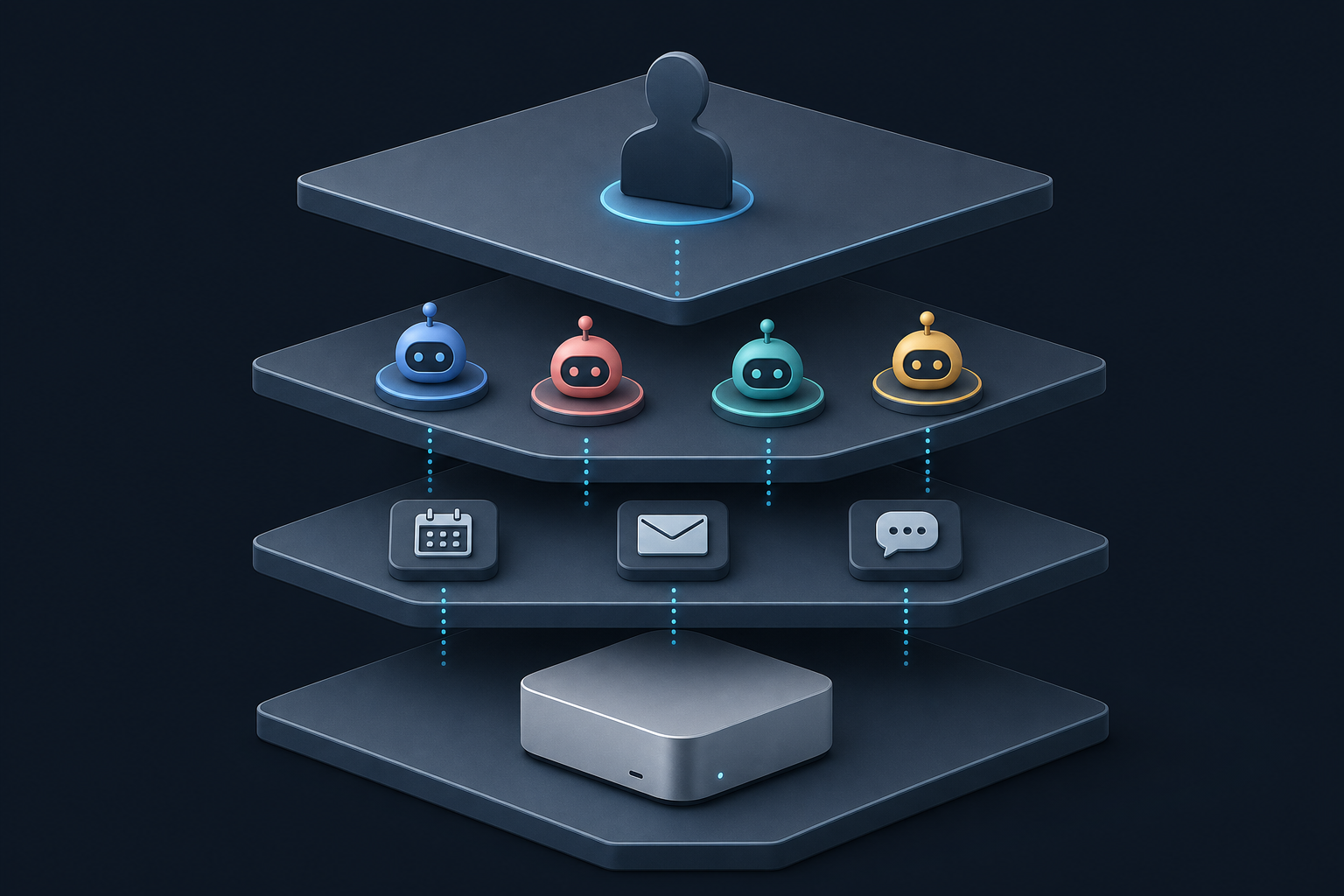
Today I run four specialized AI agents on my Mac Studio. And they run 24/7. They read my calendar and email (with my permission). They prep me for my day. They watch my investments. They draft posts in my voice. They help plan my daughter’s path to college. The possibilities are endless
Most of the work runs on a model that lives on my machine. Marginal cost for the high-volume jobs: about zero dollars a day. Sensitive work stays local unless I deliberately send it to a stronger cloud model.
You don’t need one model for all use cases. You need the right model and agent for each part of your life and what the job entails. This can be a mixture of local models on Ollama and cloud hosted models via Openrouter.
*High-volume automations on local Ollama. Finance agent uses Codex where quality under stakes matters — details below.
If you only remember three things:
- Split by domain — work, research, money, and family need different rules and memory.
- Local models cut cost and protect privacy for repetitive, structured work.
- Start with one useful morning brief. Everything else can wait.
Why bother?
I did not build this solution because I thought I needed more AI. The problem is that modern work asks one human to be a project manager, researcher, financial planner, parent/counselor, and writer.
Chatbots help with one of those jobs at a time, if you babysit them. They don’t own your rhythm. They don’t remember last week’s decision unless you paste it back in. They don’t quietly check your calendar at 6 AM and put a plan in your pocket.
What I wanted wasn’t a smarter chatbot. I wanted a fleet of agents that never sleeps, with clear job descriptions, clear boundaries, and a bill I could live with.
Where Does Hermes Fit In?
Hermes is open-source software that turns an AI model into an agent: something that can use tools (calendar, email, web), follow a schedule, and keep files that define who it is and how it should behave.
Think of it less like “ChatGPT with extra buttons” and more like hiring an assistant who lives on your computer with a job description, tool access, a memory folder, and an alarm clock. You still supervise. You still decide. You still have complete control.
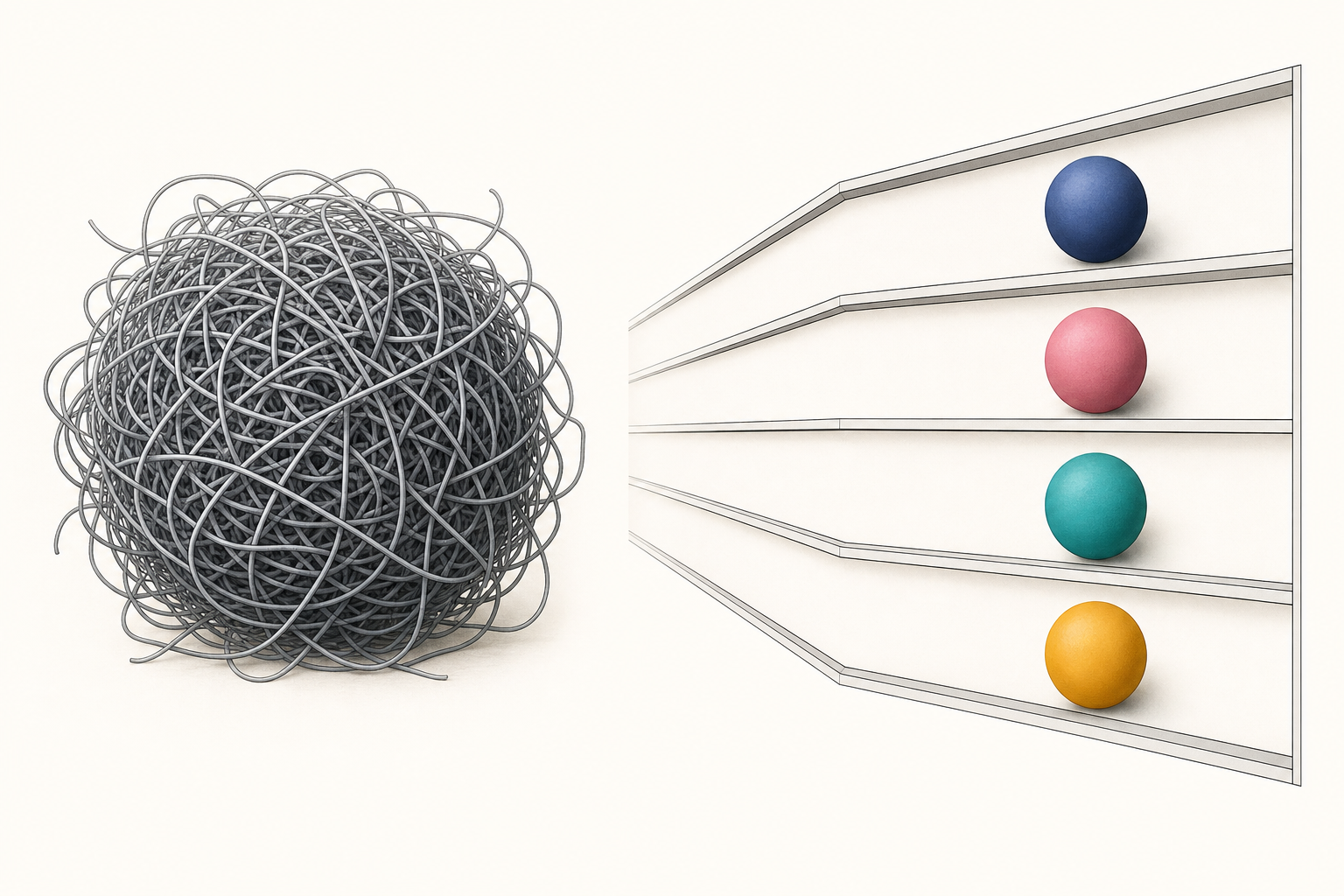
Why local models matter (cost + privacy)

| Cloud AI (ChatGPT, Claude, etc.) | Local AI (model on your Mac) | |
|---|---|---|
| Cost | Pay per message or subscription; volume jobs add up fast | Hardware is the main cost; each extra morning brief is basically free |
| Privacy | Your text leaves your machine | Your text stays on your machine (unless you choose otherwise) |
| Quality | Often stronger reasoning | Good enough for structured, repetitive work; weaker on high-stakes judgment |
| Always-on jobs | Sixteen daily automations can get pricey | Sixteen daily automations are why local shines |
I run a hybrid:
- Local (via Ollama + a ~30-billion-parameter model) for volume: daily plans, email triage, research digests, deal/news scans.
- Cloud (OpenAI Codex / GPT-5.5) only where quality under stakes matters, mainly personal finance analysis.
Don’t pay frontier prices for busywork. Don’t risk local-model inventiveness on money decisions.
The four agents
Chief of Staff
Daily plan, 1:1 prep, Gmail triage, travel briefs, talent watch, morning devotion. Delivers to Telegram.
Jess
Competitive research, LinkedIn/blog drafts in my voice, deal hunter, breaking news. Alert gates are code — not LLM judgment.
Jackie
Personal financial advisor (education, not fiduciary). Net worth, 529s, retirement, holdings news. Runs on GPT-5.5 via Codex.
Amit
College counselor for Gaby (pre-med path). Scholarships, summer programs, roadmap — fully separate memory from work and money.
| File | What it holds | Analogy |
|---|---|---|
SOUL.md | Personality, tone, boundaries | The person’s character |
AGENTS.md | How to do the job; which tools to use | The employee handbook |
USER.md | Durable facts about me / my family | The client file |
MEMORY.md | Priorities, decisions, open risks | The working notebook |
What runs automatically (before coffee)
[SILENT] unless rules qualify[SILENT] when nothing qualifies. No message beats a hallucinated price alert.
How it was set up (the real journey)
I did not wake up with four agents and sixteen jobs. The path looked like this:
- Clarify the outcome. Highest ROI ritual: morning assembly of plan + meetings + email. Highest privacy need: family and finance. Highest quality need: financial analysis.
- Treat the Mac like infrastructure. Enough RAM for a 30B-class model (~32GB+ comfortable), stays awake for 6 AM jobs, stable home network.
- Install Hermes + Ollama. Get one chat working against a local model before any automation.
- Write playbooks before cron jobs. One page each for personality, tool routing, and “never do” rules.
- Connect Google once via a canonical CLI (
gws). Prove calendar/mail outside the agent first. Expect OAuth friction; pay the tax once. - Ship one scheduled brief to Telegram. Only then add agendas, triage, research, finance, and alerts.
- Split profiles when domains fight. Finance and college counseling should never share a brain with competitive intel.
- Move alert gates into code. When LLM deal alerts get creative, replace yes/no judgment with rules.
- Add compounding memory (RAG). Research that stores itself makes Thursday smarter than Tuesday.
- Hybrid models without ideology. Local failed on finance metrics → pin Jackie to Codex; keep everyone else local for volume.
Configuration decision points
| Decision | Options | What I chose | Why |
|---|---|---|---|
| Agent shape | One mega-agent vs. many | Four domain agents | Stops context bleed; clearer safety rules |
| Models | All local / all cloud / hybrid | Hybrid | ~$0 volume cost + quality where stakes are high |
| Google access | Browser automation vs. one CLI | gws only |
Reliable, teachable in the playbook |
| Alerts | LLM judgment vs. rules engine | Python rules + [SILENT] |
Trustworthy; omission beats fiction |
| Delivery | Email vs. Telegram/Slack | Telegram + Slack (Jackie dual) | Briefs land where I already live |
| Auth sharing | Separate Google logins vs. shared | Shared Google token; isolated memory | Simpler OAuth; safer context |
Privacy boundaries (a checklist, not a vibe)
- No auto-send email — drafts only; I approve.
- Family/student detail never surfaces externally.
- Financial holdings treated as sensitive.
- Public drafts must not leak internal company numbers or customer names.
- Secret redaction on by default in Hermes.
What it costs (honest accounting)
| Item | Reality in my setup |
|---|---|
| Software | Hermes (open source), Ollama, Qdrant, Firecrawl, SearXNG |
| Hardware | Mac with enough RAM; ideally always-on for morning jobs |
| Cloud LLM | ~$0/day for local cron volume; Jackie on ChatGPT/Codex subscription |
| Your time | ~1–2 weeks to first useful morning brief; ongoing tuning forever |
| Maintenance | OAuth refresh, watchlists, memory hygiene, power management |
The cost story people miss: cloud AI looks cheap until you automate. Hourly scans and daily digests are where local models pay for the hardware.
The privacy story people miss: you don’t have to be a privacy absolutist. Route sensitive volume locally; buy frontier intelligence only for the slices that earn it.
Getting started if you’re a beginner
Do this
- Pick one draining ritual (morning plan is the highest ROI for most leaders).
- Install Hermes + Ollama and get a single chat working.
- Write one-page
SOUL+AGENTS+USERfiles — especially tool routing and “never do” rules. - Connect calendar + email with one canonical path; test outside the agent first.
- Ship one scheduled brief to Telegram or Slack.
- Only then add a second domain (finance, research, family).
- When alerts lie, move the yes/no gate into code.
Don’t do this
- Don’t start with four agents and sixteen jobs.
- Don’t paste your whole life into a cloud chat “just for now.”
- Don’t trust an LLM to decide whether a price is a deal.
- Don’t confuse meeting notes with your calendar.
- Don’t measure success by cleverness. Measure: Did a useful brief arrive without me asking?
7-day starter plan
| Day | Goal |
|---|---|
| 1 | Install Hermes + Ollama; chat works |
| 2 | Draft SOUL / AGENTS / USER (one page each) |
| 3 | Google OAuth; prove calendar/mail via CLI |
| 4 | Agent correctly answers “what’s on my calendar today?” |
| 5 | First Telegram/Slack delivery from a manual run |
| 6 | Schedule that run for tomorrow morning |
| 7 | Read the brief; fix one failure; write the fix into AGENTS.md |
If day 7 works, you already have more leverage than most “I use ChatGPT” setups.
What I’d tell my past self
- Reinvent before you optimize. Design the morning you want, then automate the assembly.
- Context is the moat. Models get cheaper. Your written rules and memory make the system yours.
- Local-first for volume; frontier for judgment. Ideology is a tax.
- Silence is a feature. Protect your notification budget like you protect your calendar.
- Playbooks over prompts. If it isn’t written down, you’ll rediscover it painfully.
- Treat the Mac like a server. Sleep settings are product decisions.
- Pin models on scheduled jobs when you change providers.
- Compound. Research that stores itself is the feeling most people haven’t had yet.
Closing
You don’t need to become a developer.
You need a clearer job description for help, a machine that can run a local model, the patience to connect the necessary tools to provide context, and the discipline to start with one brief that shows up without being asked.
The prize is leverage with boundaries: lower ongoing cost, stronger privacy defaults, and a morning that starts with decisions instead of scavenger hunts.
Start small. Pick the one weekly ritual that drains you most. Rebuild it with Hermes and a local model.
Then the next one.
Below are links to the overall detailed architecture and an interactive high level view of the solution.
— George